Saturday, July 18, 2009

Linking it all up

An App To Show You Mastercard "Priceless" Deals: Priceless.

Posted: 17 Jul 2009 12:49 PM PDT

picture-216

When I first heard that Mastercard was releasing an iPhone app called "Priceless Picks," I thought for sure it would be a lame gimmick. But I must admit, it's actually a kind of cool gimmick.

If you've ever watched TV, you've undoubtedly seen at least a dozen of the Mastercard "Priceless" ads. You know the ones, "So and so consumer items: $5. Such and such memorable moment paid for with your Mastercard: Priceless." Yeah, now there's an app for those.

Well not exactly. It's not like this app is limited to the priceless moments mentioned in the commercials, that would be kind of pointless. Instead this is a social app that allows consumers to point out their best deals at their favorite local spots for all to see. The app uses the iPhone location services to figure out where you are. It then shows you on a map and shows all the deals others have placed around you.

That may sound bland and obvious, but the app is actually done in a really nice way. You can choose either a bird's eye view of the deals around you on the map, or get a more street-view like look (though, sadly, it doesn't use the iPhone 3GS' new compass to move the map when you move). If you tap on any of the color-coded bubbles, you zoom into that specific deal and can tap to get more info about it.

picture-118You can also flag the deal is "improper" or send it to a friend, all without leaving the app. It also tells you when (if ever) the deal expires.

If you want to add you own deal, you simply click the "+" button, and enter the relevant details. It will tag the place at whatever your current location is.

So will anyone actually use this app? Who knows. But if Mastercard starts promoting it on their annoyingly effective commercials, I could certainly see a bunch of tourists picking up this app to find some deals in whatever city they happen to be in.

The best part of this "priceless" app is that it really is price-less, as in, free. Find it here.

Thursday, July 16, 2009

book it danno

Dopplr launches iPhone app anyone can use, but where's Add Trip?
by Mike Butcher on July 16, 2009

Dopplr has launched an iPhone app they are billing as a "social atlas". Curiously, and possibly wisely, you don't even need an account at Dopplr to use the app, meaning it will get exposed to a lot more potential users. However, a let down from the get-go is that you can't add upcoming trips from within the app right now, which is kinda the point with Dopplr, as it's users will attest. Hopefully that feature will be out soon. Till then if you want to add trips on mobile people can use the site, twitter, SMS or email in the usual manner, of course.

The app appears first on the iPhone, but apps for Nokia, Blackberry and Google Android platforms are planned. The app is available from the iTunes store here. But for Dopplr users it's going to be a real boon. The app puts the combined knowledge of your Dopplr network into an app which can tell your location, while allowing users to upload reviews themselves. There is also a built-in directory of city tips and advice. Plus, as usual, see where your network is about to travel to so you can plan accordingly. Users can also contact eachother directly from inside the app. There is plenty of content inside the app pulled from Dopplr's own content as well as your social network.

The question mark with Dopplr is how it will continue to fair against Tripit, which is tearing along at a fast pace and recently launched premium flight monitoring and alerts.

Thursday, June 25, 2009

Touring About

Google Dips Its Toe Into Travel Space With City Tours
by Jason Kincaid on June 24, 2009


Google has just debuted the latest entry to its fleet of Labs products, introducing the search giant to the travel space. Dubbed City Tours, the new site can build itineraries for brief trips to locations around the globe in a matter of seconds. At this point details on the new product are fairly sparse — it looks like Google hasn't written its customary blog post yet, but given how basic the product is it's pretty easy to figure out how it works.

Getting started is incredibly easy — just type in where you're visiting (say, San Francisco or London), and Google will present a suggested itinerary spanning a three day trip, with around a dozen attractions per day depending on the city. From there you can change the number of days you'll be staying (Google will show more attractions the longer you stay), and you can also manually adjust the list of places you'd like to visit. You can add a new attraction by entering its name in a text field, and Google will try to find it in its database. All attractions include a star rating, along with its hours operation and location.

For the most part adding attractions works pretty well (which is going to be key given that you can't expect Google to predict everything you'll want to see). It managed to find the London Eye perfectly, and it even figured out that Platform 9¾ was located at the King's Cross Rail Station. That said, it isn't perfect: a search for Hyde Park directed me to a nearby hostel, which I suppose would have gotten me there but probably isn't the ideal result.

Perhaps the coolest part of the new product is the way it uses Google Maps to figure out which locations are closest to each other. Rather than simply present a list of places Google thinks you might want to check out, the site will logically order them according to where they're located, minimizing the travel time between each.

Given its status as a Labs product this shouldn't come as much of a surprise, but there are still a few kinks in City Tours. For one, I am apparently unable to remove events from my suggested itinerary (I've tried in both Firefox and Safari with the same issue). Likewise, sometimes when I click on the name of a location nothing happens. And it badly needs support for Google Transit, which can automatically route you across town using public transportiation — my London tour included a 99 minute walk that would have only been a couple minutes away had I ridden on the Tube.

In the mean time, there are plenty of other travel sites that offer similar (and in many cases, more robust) functionality than Google's City Tours, including TC50 finalist GoPlanitOffbeat Guides, and Zicasso.

Booking yourself


BookFresh Is OpenTable For Everything Else

Posted at TechCrunch: 24 Jun 2009 11:57 PM PDT

33

In the online reservation space, you probably know about OpenTable. The restaurant reservation service's IPO in a time of drought for IPOs, made big headlines. Now imagine OpenTable for just about everything besides restaurants. That's BookFresh.


Who might need such a service? A lot more services and individuals than you may realize. While most services have some sort of scheduling system, many aren't optimized, and can't adapt on the fly to openings/changes. Massage therapists, dentists, doctors are all perfect examples of who could use such a system, founder Ryan Donahue tells us. He notes that health and beauty has been a particularly hot area.


He knows that because the service has actually been around for a little while, but it was formerly know as HourTown. But BookFresh is a much better name for the service because, "appointments are much like produce items in a grocery store, it's a perishable thing," Donahue says.


And a name change isn't all that in-store for users. BookFresh wants to be the main platform for all online appointment booking on the web. As such, they've created APIs to let developers of sites take advantage of their tools. But you don't have to be a developer to implement the service, anyone can do it with a simple line of code added to their site. This is important because a lot of people BookFresh is targeting are one-person or small operations, that probably don't have a web development team.


Donahue likens the idea of BookFresh as an appointment platform to PayPal as a payment platform. (And he should know, he used to work at PayPal — incidentally with Jeffrey Jordan, the CEO of OpenTable.) He notes that just like a lot of sites out there don't want to go through the hassle of building their own payment system, they also don't want to have to make an online booking system. Sure, it's not as complex, but it's still a hassle — and might as well be impossible for little shops/services.


And BookFresh offers some nice things with its platform. One is the ability for businesses that use it to get calls when a customer is requesting an appointment time. From your phone, you can opt to accept or decline the request. That's perfect for someone like a plumber, who may be always on the go and not able to get to a computer to confirm appointments. And the offers easy integration with Google Calendar and iCal to place appointments in your own personal calendars automatically when you accept them.


Alongside the name change, BookFresh is announcing a partnership with Webs.com, one of the largest sites for building free websites out there. A lot of small business owners are already using it, and now they'll have one click access to install BookFresh if they choose to.


In terms of monetization, the service is free for the end user, but businesses/individuals who wish to use it will pay a month fee that starts at $19.95. If larger sites choose to sign-on, there are other deals such as revenue sharing that can take place.


In terms of competition, there is Appointment-plus, but their service forces you back to their servers to handle everything. BookFresh's platform allows users to stay on the page they are already on to set everything up, Donahue says.


One service that BookFresh won't be competing with is OpenTable. They have no interest in getting into the restaurant space, Donahue says.

Saturday, May 09, 2009

...

Ex-Googlers Try To Create A Better Travel Guide With Nextstop

Posted: 08 May 2009 01:10 PM PDT

Are you looking for the best beer bars in the world, good places to make out in San Francisco, or where to go on the Big Island in Hawaii? A travel recommendation site called nextstop mixes social recommendations with search and adds a reputation system and elements of gameplay to come up with a new social online travel guide.

The site has been in beta for a few months, although it hasn't gotten much attention yet. It was started by a couple of ex-Googlers, Carl Sjogreen and Adrian Graham, who helped launch Google Calendar (Sjogreen) and Google Groups, and Picassa (Graham). A third co-founder, Charles Lin, was a Stanford classmate of Graham's. The site grew out of their frustration with finding interesting things to do in unfamiliar places. "It is difficult to discover something new when you don't know what to look for," says Sjogreen.

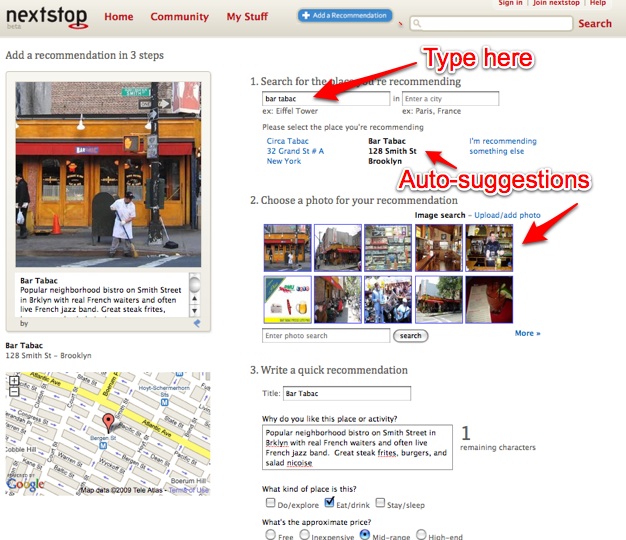
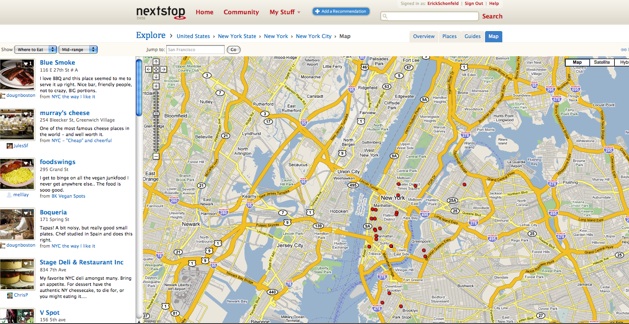
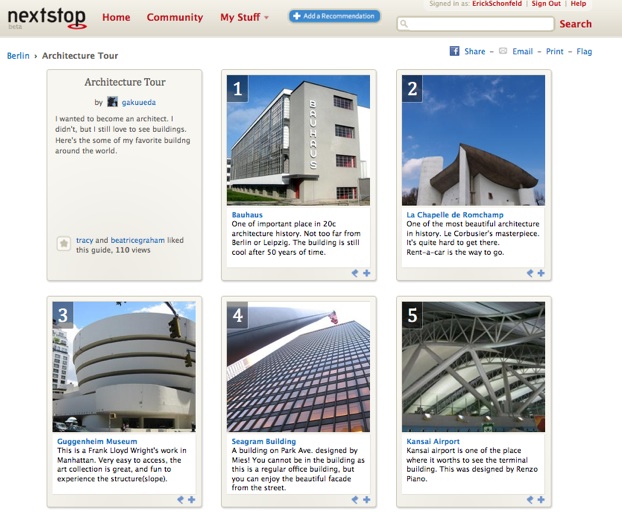
Everything on nextstop is geared towards getting people to recommend their favorite places and organize those recommendations into guides. There are various ways to explore the site, including a search box, by city, a guide view, or a map view (see screen shots below). The recommendations can be collected together into guides (like this one for an architecture tour), which can be explicitly "liked" by members. The guides can be sorted by most recent, most liked, or most viewed. You can save any place or guide in a wishlist for later viewing.

But it is the social aspects which give the site an extra edge. Each recommendation acts as a vote (for any given place, you can see how many people recommend it) and you can also vote individual recommendations up and down. Every member gets areputation score. You get 2 points every time somebody else votes up one of your recommendations, and 15 points when they "like" one of your guides. To fight spam, your reputation score goes down every time somebody votes down one of your recommendations or flags one of your entries. Entries can also be edited wiki-style. Still, it would be fairly easy to game the system with a few friends.

The members with the most points get recognized on a leaderboard. And you can follow any other member, which lets you see all of their entries and actions on the site in an activity stream (which you can export to other services as an RSS feed). In addition to the reputation points, members can also earn "badges" for accomplishing certain goals, such as being the first to recommend a place, for getting 100 views on a guide, or 10 likes. Any recommendation can be shared via email, Facebook or Twitter (but sharing is not automatic, it has to be explicitly selected for each recommendation). Individual guides can also be shared as embeddable badges or widgets.

The site makes very simple to create a recommendation. These are not meant to be in-depth reviews, rather curated suggestions of things to do. It uses a combination of search APis from Google (for local search, geo-location, image search, and maps) and Yahoo Boss (also for image search) to help you find and auto-complete many of the items that go into each recommendation.

Once you create an account or sign in using Facebook Connect, you can type in the name of practically any bar, restaurant, tourist attraction, or business after clicking "add a recommendation." It will suggest places it recognizes along with their addresses, and if one of them is what you are trying to recommend, you click on it and nextstop will place it on a Google map and find pictures. You pick an image, add a short Twitter-length recommendation no more than 160 characters, and categorize it as a place to eat/drink, stay/sleep, or do/explore along with an approximate price range (free, inexpensive, mid-range, high-end). Then the recommendation is created and other people can find it on the site. I did this for a restaurant in my neighborhood in Brooklyn, Bar Tabac, and it found it immediately, along with a great picture.

There is plenty of competition for online travel guides and social recommendations, starting with TripAdvisor and Yelp down to a bevy of startups including DopplrOffbeat Guides and TripSay. But nextstep manages to do things a little bit different. It is not trying to be comprehensive, it is just trying to provide travelers a highly selective and vetted list of things to do and places to visit.


Wednesday, May 06, 2009

Sustainability's last public gasp

The Coming End of YouTube, Twitter and Facebook Socialism

Thank God for Tech Moguls Who Redistribute VC Wealth So We Can Cybersocialize Freely. For Now, That Is.

Twitter founders Ev Williams and Biz Stone should thank God it was just a cardinal, and not the pope.

Last week, according to the Times of London, Cardinal Sean Brady of Ireland told the country's Catholics to "Make someone the gift of a prayer through text, Twitter or e-mail every day. Such a sea of prayer is sure to strengthen our sense of solidarity with one another."

LET US PRAY: Cardinal Sean Brady wants you to tweet for Jesus.
Photo Credit: Niall Carson

Oh, my. That's a nice sentiment, but Twitter really doesn't need more users around the world tweeting in ways that can never be monetized. Ireland's got just 4 million Catholics, but the Vatican counts more than a billion baptized Catholics worldwide. If the 
pope endorsed tweeting prayer, Twitter could be out of business by the end of the year! The 3-year-old company, remember, still lacks a revenue model and just burns through more venture capital every time a new user signs up. (Fortunately, given how retro-conservative Pope Benedict is, he seems more likely to issue a papal encyclical condemning Twitter. We all know it's more likely to enable sin -- pride! sloth! -- than piety.)

It's telling that Cardinal Brady grouped Twitter with texting and e-mail. The former, of course, is a paid service and a massive profit center for cellular carriers around the world, and the latter you also pay for, albeit indirectly, as a service bundled with your monthly internet access or by allowing yourself to be subjected to advertising. (As a Gmail user, I decided to see what would come up when I e-mailed myself the Lord's Prayer. The ads Google served included ones for BeliefNet and Don Helin's paperback pulp thriller "Thy Kingdom Come." Ka-ching!) But when it comes to Twitter, we not only don't pay, but we all take it for granted that somebody's going to keep footing the bill for the rapidly expanding server farms needed to process and store zillions of tweets per minute.

It's sweet, really, that venture capitalists have ponied up millions so that we can all keep tweeting. It's also more than a bit scary. Because more and more of us are increasingly addicted not only to Twitter, but to other services that lack workable business models. What happens if the "dealers" who feed our habits disappear? (It's been known to happen. Last week, for instance, Yahoo announced it was shutting down last century's hot social-networking-esque service, GeoCities, for which it paid $3.5 billion in 1999.)

I've been thinking about all this a lot since I wrote, a few weeks ago, about how Susan Boyle has been on what I called the "Google Dole" -- her fame fueled in a nonsensically nonprofit manner by Google's YouTube unit, which hemorrhages cash serving up too much video with nowhere near enough advertising support. (I'll again refer you to Benjamin Wayne's Silicon Alley Insider piece, "YouTube is Doomed,"which deconstructed the recent Credit Suisse report that puts YouTube's estimated 2009 losses at nearly half a billion dollars.) You'd think a clip of Boyle singing a song from "Les Misérables," one of the most popular musicals of all time, on one of the most popular TV shows in the world would be semi-monetizable. (I mean, geez, at the very least stick a pop-up overlay on that video with a link to the "Les Miz" soundtrack on iTunes.) But no. Adam Ostrow at Mashable further proved my point with his piece, "Susan Boyle Video Profits: $0," which explained that disagreement between "Britain's Got Talent" owner ITV and YouTube over pre-roll vs. overlays prevented ad placements in Boyle's YouTube streams.

And then last week The New York Times reported about the hazards of international expansion for the likes of Facebook. Getting million of new users in the Third World, it turns out, really sucks, because Facebook will never really be able to meaningfully monetize those eyeballs. It's tons of cash out (bandwidth, data storage, personnel) with little hope of cash in.

Weirdly, some of the management at these companies don't even seem to be trying that hard to make money -- a consequence, perhaps, of still being awash in millions of dollars of VC money ("venture charity," as I like to call it). In fact, Abbey Klassen, Ad Age's digital editor, tells me that she once heard a Facebook exec joke to an agency exec, "Didn't you know we're a nonprofit?"

I'll go one step further: They're socialists! OK, yes, I'm using the dumbed-down definition of socialism championed by numbskulls like Sarah Palin, but regardless of the finer points of economic theory, you've got to admit that at some level the boys at Facebook, YouTube and Twitter are actively choosing to redistribute the wealth. They're taking money from venture capitalists and deploying it so that millions of people far beyond Silicon Valley can get something for nothing. Entertainment, information, and self-marketing opportunities, mostly.

And, oh yeah, a sense of "connectedness" -- cyber companionship -- which makes this particular era of VC-wealth distribution all the more ... touching. (Let's all be friends -- on someone else's dime! Let's all be perpetually jacked into the hyper-insta-now global hivemind of human consciousness -- for free!)

I am so appreciative. Seriously. I love YouTube, I've made some interesting connections through Facebook, and I enjoy Twittering. (Last week, for instance, I tweeted about an astonishing bit of information I came across in Britain's Daily Telegraph: YouTube "reportedly uses as much bandwidth as the entire internet took up in 2000.")

But I also know it can't go on like this. The digital Robin Hoods can't keep redistributing the wealth forever, because eventually the wealth runs out. Investors get sick of propping up private ventures that don't have viable business models, and shareholders of public companies, like Google, get cranky about flushing cash down the drain.

So what can we do? Not much, I suppose, other than enjoy it while it lasts -- and maybe twitter a prayer for VCs everywhere.

~ ~ ~
Simon Dumenco is the "Media Guy" media columnist for Advertising Age. You can follow him on Twitter 
@simondumenco

Monday, April 27, 2009

Getting to the point

Have Kindle, Will Travel — And Stay Up-To-Date Thanks To Offbeat Guides

Posted: 26 Apr 2009 10:00 PM PDT

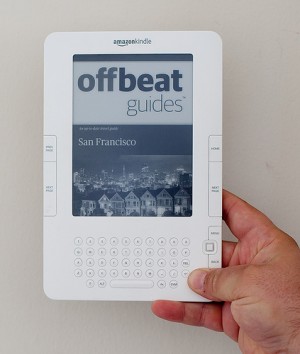
3476985377_9ce509d49aI used to think the Kindle was stupid. Then I bought one and realized I was wrong. It's still way too expensive, but it's great at what it does. And what it does keeps on expanding. Now, it takes a step into the up-to-date travel guide market, with a partnership with the customizable travel guide service, Offbeat Guides.

Starting tomorrow, you'll be able to find 500 of the company's newest guides in the Kindle store at prices ranging from $3.99 for smaller cities to $7.99 for larger ones. Here's why these are great. Just like the Offbeat Guides regular guidebook products, its Kindle-ready guidebooks are way more up-to-date than traditional guidebooks. While there have been some guidebooks available on the Kindle in the past, most are only updated once a year. Offbeat Guides are updated every month.

This means they can include information such as real-time events for specific cities, like concerts or festivals. It also means the guides can have a Kindle menu option to find out something going on in the city you are visiting that night. For tourists who don't know anyone in a particular city, that's a great feature.

There are a couple downsides. Naturally, because the Kindle only handles grayscale images, you won't get the full color pictures you usually find in other tour guides. And because the Kindle's screen isn't ideal for displaying maps, tailored, local maps that are a part of Offbeat Guides regular guides aren't included here.

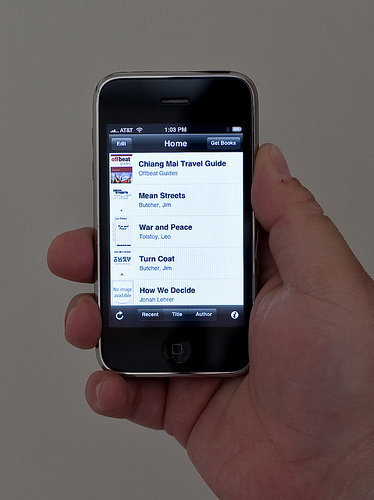
But, at 10.2 ounces (for the latest version), the Kindle is likely lighter than regular tour guides. And, if you're planning a multiple city trip, you can obviously load up a bunch of these guides on one Kindle. One thing that particularly excites me is the fact that you can also view these on your iPhone if you go somewhere and don't feel like carrying around a Kindle. Because the Kindle app on the iPhone stays in sync with the Kindle content, you can bookmark pages and look at them later on your phone.

Offbeat Guides has been working on these Kindle-tailored guides for 6 months now, CEO Dave Sifry tells me. He also notes that there are 5 times as many cities available as compared to other guides. Right now, if you plan on traveling to a city often and want the most up-to-date guide, you'll have to buy a new one each time. But Sifry says they will explore the possibility of having subscriptions for certain cities if customers demand that. Such a feature may even be useful to locals of a particular city to know what is going on. But the focus right now remains on leisure and business travelers, he says.

Find a full list of the Offbeat Guides Kindle options here.

Table of Contents of the May 2009 San Francisco Offbeat Guide on 3477796562_c9ed04f47d

Blog Archive