Thursday, October 12, 2006
 This radio is a great one for travellers, language enthusiasts and those far away from home with a passion for radio from around the world. You'll be able to tune into thousands of stations and as the radio is digital, it'll all be crackle free. Not only that but this WiFi radio can access all your music on your PC without having to turn the computer on. Stations are listed alphabetically and you can use the preset to select up to 10 favourites. RRP £119.99

Mio H610 Personal Assistant SatNav

The Mio H610 isn't just any old personal assistant, it's a SatNav too with on foot and in car navigation with 24 European maps displayed on a 2.7 inch touch screen, a photo viewer an MP3 player with 17 hours of playback, video player, currency converters and games. Internal memory is 1GB but a SD/MMC card can add 4GB more At around the size of a pack of cards, it's definitely pocket friendly that way plus the two supplied covers are interchangeable, the one shown is a white flower design. It'll hit the shops in early November with a RRP of £269.99
Acer e-Series GPS
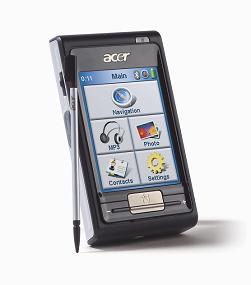
It's not pink, but it is apparently the perfect size for our handbags (they clearly haven't seen the size of mine - I could fit a whole car in), so it can still be classed as GPS for Girls. Praise be! However, facetiousness aside, it is pretty tiny at 103 x 58.4 x 17.5 mm and weighing just 130 grams. It's also finger-friendly as opposed to stylus-stabbing, as well as loads of Points of Interests and decent maps. There's also an integrated MP3 player, and a photo viewer.
There are three models available. The e305 has UK maps and POI, the e310 has European maps, pedestrian mode and an AC-Adaptor and the e360 comes with live traffic information. Pricings yet to be released.
More car stuff: Navman F20| Hot Pink CarTrek| Barbie's
Tuesday, October 10, 2006
Smalltown and GrayBoxx
Smalltown and GrayBoxx: Two approaches to local search and two approaches to tapping the Yellow Pages gold mine
By Tom Foremski for Silicon Valley Watcher
Local search and local online commerce are the next battlegrounds for the giants such as Google and Yahoo, but also for many startup companies. The lure is the billions of dollars spent on Yellow Pages advertising by local businesses.
We have Yahoo Local and Google Local, plus Max Levchin's Yelp, CitySearch, Ingenio, plus local newspapers and other companies--all trying to grab a piece of the local search and local commerce ad spend.
But tapping into the local businesses market through online services is hard. The same factors that make scaling a global online service easy on the Internet become reversed when applied to local businesses.
For example, a local pizza parlor gets nearly all its business from within two miles of where it operates. Reaching China or even a neighborhood five miles away is something the Internet does well for many companies. But it doesn't make much sense for a local pizza parlour, and the same is true for most local businesses--they all nned to reach customers in their neighborhoods.
I recently spoke with two startups, Smalltown and Grayboxx, with two different approaches.
Smalltown targets neighborhoods and small communities
I was very impressed with Smalltown's approach to local search because of the elegant design and simplicity of the site. Simplicity is not easy to do but it is extremely vital in the online space.
Last week I spoke with Smalltown CEO Hal Rucker. "To succeed in local markets we belive that you have to be local," said Mr Rucker. "So we've created 'webcards' which are a type of virtual index cards with their own web address that can be created by anyone local, by a business or an individual."
An example of a webcard:
Webcards can be attached to each other, and also sent to people. They provide an easy to use template that allows busy, small business owners to create a web page about their business without having to have a website.
And the process is simple enough that any customer of a local business can create a webcard that acts as a recommendation, or a warning, by filling in text and adding photos.
"With webcards we are helping to build what we call the 'local web.' And it creates 'social advertising,'" said Mr Rucker.
The roll out of Smalltown will be town by town. The first two are San Mateo and Burlingame, in the heart of Silicon Valley.
If they can get the formula right, then they can reproduce it in other small towns and city neighborhoods.
Each Smalltown would have a local person/agent to help evangelize the service and also aid local businesses and people to produce webcards. Smalltown is =offering cash bounties to people of $5 per five webcards, a smart way to create a large inventory of webcards, which creates a potentially useful library of local content.
SVW's take: Smalltown has a great user interface and I love the concept of webcards, each with their own web address, each discoverable through the search engines, as well as the local Smalltown portal.
What I'd like to see with such approaches is a compelling front end, by which I mean a reason to go to the site even if I'm not actively searching for something local. What would draw me to it if I did not have a need to find something? I've got a couple of ideas...
Coming up next in SVW: Interview with Bob Chandra, founder and CEO of Grayboxx (still in stealth mode). This local search startup taps unseen databases to create ranked lists of top local businesses favored by their communities. . .
Thursday, October 05, 2006
Iran 'to open atomic site tours'
| Iran 'to open atomic site tours' | ||
No details were given on the nature of the trips, or when they might begin. Possible attractions would include the plants at Isfahan and Natanz, or a reactor being built in Bushehr. The reported proposal comes after the UN Security Council has told Tehran to halt uranium enrichment, amid fears it is trying to build nuclear arms. Iran maintains it has a right to a nuclear programme, which it says is purely for civilian purposes. 'Peaceful' So far United Nations atomic watchdog inspectors and reporters are the only foreigners believed to have been allowed to visit the controversial sites. The head of Iran's tourism organisation said President Mahmoud Ahmadinejad had asked his group to study ways for tourists to see the sites, state news agency Irna reported. "This authorisation has been issued since the Iranian nuclear activities are peaceful," Esfandyar Rahim Mashaii told the agency. | ||

Wednesday, September 27, 2006
Travel planning becomes a do-ityourself occupation
The Internet has changed forever how people purchase travel, and those who pitch hotels or destinations need to get on board or get left in the low-tech dust.
"Today's customers are time-starved, tech-savvy and information-rich," Travelocity.com founder Terry Jones told local tourism leaders at the Scottsdale Convention & Visitors Bureau's annual meeting Friday at Camelback Inn in Paradise Valley.
Americans and their computers or PDAs have turned travel planning into a do-ityourself occupation, he said.
By 2009, they will be spending $100 billion a year on online travel purchases, Jones said. Already, 68 percent of the U.S. population is online, and 79 percent of U.S. travelers are.
Even more important, Jones said, 98 percent of college kids have made an online purchase. "And today's college students are next year's consumers," he said.
"You need to fish where the fish are," Jones said.
Get the full story at the East Valley Tribune
Monday, September 25, 2006
Online customers take flight from poor travel sites
Online travel companies are missing out on bookings or driving customers to rival sites because of poor web site design or user experiences, according to new research.
The study of more than 25 travel web sites suggests that cumbersome search engines, hard to find booking forms and hidden charges are the biggest mistakes.
Webcredible, who carred out the research, says a lack of print-friendly page designs and not promoting competitive prices on home pages also caused people to click away.
'The travel sector experiences one of the highest levels of comparison shopping online. A massive one in four visits to travel web sites come from another site in the same category,' said Webcredible director Trenton Moss.
'Users are unlikely to hang around for long if they can't find what they are looking for, but by making a number of easy-to-implement changes online travel companies can significantly improve the satisfaction of their web site visitors. This would ultimately lead to increased bookings and revenue.'
Subscribe to:
Posts (Atom)