Tuesday, August 18, 2009

From Another source

August 11, 2009

TRAVELGROVE META SEARCH ENGINE REVIEW

http://www.travel-plan-idea.com/archives/004839.html


The following is a paid review.

When I first heard of Travelgrove I was reminded of Kayak because it was described as "a meta search engine that helps its users find the best deals on airfares, hotel rentals, car rentals, cruise deals and vacation packages."

I don't believe you can search for all that on Kayak so I was looking forward to a more comprehensive travel search engine when I started trying it out. I went to the vacation search engine, which I presumed would include flight + hotel packages and searched for a trip from JFK to Prague Sept. 18-25.

The results were pretty disappointing. There were some unrelated travel deals (for example Flight from Boston (BOS) to New York City (JFK) from $79). There were some hot deals and I thought the first must be related to my search: $219 & up -- Europe on Sale this Fall on Lufthansa. The other hot deals were not really close though. For example one was $625 & up -- Caribbean Iberostar Vacations w/Air, $150 OFF.

There was a button encouraging me to search Travelocity, Hotwire travel-ticker, and Bookingbuddy. But Travelgrove itself gave me no useful results.

I next went to the travel guides section, and figured I'd review the one on South Korea since I think of myself as kind of an expert. I was expecting something more detailed but the information I found was very general in nature. I don't think anyone could begin planning a vacation with this travel guide. They list a few tourist attractions but there's really not much there for travelers to read.

I next went to the community, thinking it would be a message board. They seem to be encouraging travel journals more than forums although the one I clicked on was actually a few sets of pictures (Salzburg and Vienna). I did see a link for forums but I got an error message so I was never able to check them out. Perhaps when they're fixed I can edit this review to include something on the forum community.

Thursday, July 23, 2009

Set-top productions

Coronation Street goes on Google Street View

Corrie goes on Google Street View

 Coronation Street is to become the first fictional location to appear on Google Street View.

The soap's producers have invited one of the site's camera cars to drive down the famous cobbles and take pictures of the set.

Fans will be able to explore the street virtually and take in well-known landmarks such as the Rovers Return, the hairdresser's and Rita's paper shop, The Kabin.

An ITV spokesman said: "Thanks to Street View, fans will be able to have a good nose around the set in a way that would have been unimaginable almost 50 years ago when the show first aired."

Saturday, July 18, 2009

Linking it all up

An App To Show You Mastercard "Priceless" Deals: Priceless.

Posted: 17 Jul 2009 12:49 PM PDT

picture-216

When I first heard that Mastercard was releasing an iPhone app called "Priceless Picks," I thought for sure it would be a lame gimmick. But I must admit, it's actually a kind of cool gimmick.

If you've ever watched TV, you've undoubtedly seen at least a dozen of the Mastercard "Priceless" ads. You know the ones, "So and so consumer items: $5. Such and such memorable moment paid for with your Mastercard: Priceless." Yeah, now there's an app for those.

Well not exactly. It's not like this app is limited to the priceless moments mentioned in the commercials, that would be kind of pointless. Instead this is a social app that allows consumers to point out their best deals at their favorite local spots for all to see. The app uses the iPhone location services to figure out where you are. It then shows you on a map and shows all the deals others have placed around you.

That may sound bland and obvious, but the app is actually done in a really nice way. You can choose either a bird's eye view of the deals around you on the map, or get a more street-view like look (though, sadly, it doesn't use the iPhone 3GS' new compass to move the map when you move). If you tap on any of the color-coded bubbles, you zoom into that specific deal and can tap to get more info about it.

picture-118You can also flag the deal is "improper" or send it to a friend, all without leaving the app. It also tells you when (if ever) the deal expires.

If you want to add you own deal, you simply click the "+" button, and enter the relevant details. It will tag the place at whatever your current location is.

So will anyone actually use this app? Who knows. But if Mastercard starts promoting it on their annoyingly effective commercials, I could certainly see a bunch of tourists picking up this app to find some deals in whatever city they happen to be in.

The best part of this "priceless" app is that it really is price-less, as in, free. Find it here.

Thursday, July 16, 2009

book it danno

Dopplr launches iPhone app anyone can use, but where's Add Trip?
by Mike Butcher on July 16, 2009

Dopplr has launched an iPhone app they are billing as a "social atlas". Curiously, and possibly wisely, you don't even need an account at Dopplr to use the app, meaning it will get exposed to a lot more potential users. However, a let down from the get-go is that you can't add upcoming trips from within the app right now, which is kinda the point with Dopplr, as it's users will attest. Hopefully that feature will be out soon. Till then if you want to add trips on mobile people can use the site, twitter, SMS or email in the usual manner, of course.

The app appears first on the iPhone, but apps for Nokia, Blackberry and Google Android platforms are planned. The app is available from the iTunes store here. But for Dopplr users it's going to be a real boon. The app puts the combined knowledge of your Dopplr network into an app which can tell your location, while allowing users to upload reviews themselves. There is also a built-in directory of city tips and advice. Plus, as usual, see where your network is about to travel to so you can plan accordingly. Users can also contact eachother directly from inside the app. There is plenty of content inside the app pulled from Dopplr's own content as well as your social network.

The question mark with Dopplr is how it will continue to fair against Tripit, which is tearing along at a fast pace and recently launched premium flight monitoring and alerts.

Thursday, June 25, 2009

Touring About

Google Dips Its Toe Into Travel Space With City Tours
by Jason Kincaid on June 24, 2009


Google has just debuted the latest entry to its fleet of Labs products, introducing the search giant to the travel space. Dubbed City Tours, the new site can build itineraries for brief trips to locations around the globe in a matter of seconds. At this point details on the new product are fairly sparse — it looks like Google hasn't written its customary blog post yet, but given how basic the product is it's pretty easy to figure out how it works.

Getting started is incredibly easy — just type in where you're visiting (say, San Francisco or London), and Google will present a suggested itinerary spanning a three day trip, with around a dozen attractions per day depending on the city. From there you can change the number of days you'll be staying (Google will show more attractions the longer you stay), and you can also manually adjust the list of places you'd like to visit. You can add a new attraction by entering its name in a text field, and Google will try to find it in its database. All attractions include a star rating, along with its hours operation and location.

For the most part adding attractions works pretty well (which is going to be key given that you can't expect Google to predict everything you'll want to see). It managed to find the London Eye perfectly, and it even figured out that Platform 9¾ was located at the King's Cross Rail Station. That said, it isn't perfect: a search for Hyde Park directed me to a nearby hostel, which I suppose would have gotten me there but probably isn't the ideal result.

Perhaps the coolest part of the new product is the way it uses Google Maps to figure out which locations are closest to each other. Rather than simply present a list of places Google thinks you might want to check out, the site will logically order them according to where they're located, minimizing the travel time between each.

Given its status as a Labs product this shouldn't come as much of a surprise, but there are still a few kinks in City Tours. For one, I am apparently unable to remove events from my suggested itinerary (I've tried in both Firefox and Safari with the same issue). Likewise, sometimes when I click on the name of a location nothing happens. And it badly needs support for Google Transit, which can automatically route you across town using public transportiation — my London tour included a 99 minute walk that would have only been a couple minutes away had I ridden on the Tube.

In the mean time, there are plenty of other travel sites that offer similar (and in many cases, more robust) functionality than Google's City Tours, including TC50 finalist GoPlanit, Offbeat Guides, and Zicasso.

Booking yourself


BookFresh Is OpenTable For Everything Else

Posted at TechCrunch: 24 Jun 2009 11:57 PM PDT

33

In the online reservation space, you probably know about OpenTable. The restaurant reservation service's IPO in a time of drought for IPOs, made big headlines. Now imagine OpenTable for just about everything besides restaurants. That's BookFresh.


Who might need such a service? A lot more services and individuals than you may realize. While most services have some sort of scheduling system, many aren't optimized, and can't adapt on the fly to openings/changes. Massage therapists, dentists, doctors are all perfect examples of who could use such a system, founder Ryan Donahue tells us. He notes that health and beauty has been a particularly hot area.


He knows that because the service has actually been around for a little while, but it was formerly know as HourTown. But BookFresh is a much better name for the service because, "appointments are much like produce items in a grocery store, it's a perishable thing," Donahue says.


And a name change isn't all that in-store for users. BookFresh wants to be the main platform for all online appointment booking on the web. As such, they've created APIs to let developers of sites take advantage of their tools. But you don't have to be a developer to implement the service, anyone can do it with a simple line of code added to their site. This is important because a lot of people BookFresh is targeting are one-person or small operations, that probably don't have a web development team.


Donahue likens the idea of BookFresh as an appointment platform to PayPal as a payment platform. (And he should know, he used to work at PayPal — incidentally with Jeffrey Jordan, the CEO of OpenTable.) He notes that just like a lot of sites out there don't want to go through the hassle of building their own payment system, they also don't want to have to make an online booking system. Sure, it's not as complex, but it's still a hassle — and might as well be impossible for little shops/services.


And BookFresh offers some nice things with its platform. One is the ability for businesses that use it to get calls when a customer is requesting an appointment time. From your phone, you can opt to accept or decline the request. That's perfect for someone like a plumber, who may be always on the go and not able to get to a computer to confirm appointments. And the offers easy integration with Google Calendar and iCal to place appointments in your own personal calendars automatically when you accept them.


Alongside the name change, BookFresh is announcing a partnership with Webs.com, one of the largest sites for building free websites out there. A lot of small business owners are already using it, and now they'll have one click access to install BookFresh if they choose to.


In terms of monetization, the service is free for the end user, but businesses/individuals who wish to use it will pay a month fee that starts at $19.95. If larger sites choose to sign-on, there are other deals such as revenue sharing that can take place.


In terms of competition, there is Appointment-plus, but their service forces you back to their servers to handle everything. BookFresh's platform allows users to stay on the page they are already on to set everything up, Donahue says.


One service that BookFresh won't be competing with is OpenTable. They have no interest in getting into the restaurant space, Donahue says.

Saturday, May 09, 2009

...

Ex-Googlers Try To Create A Better Travel Guide With Nextstop

Posted: 08 May 2009 01:10 PM PDT

Are you looking for the best beer bars in the world, good places to make out in San Francisco, or where to go on the Big Island in Hawaii? A travel recommendation site called nextstop mixes social recommendations with search and adds a reputation system and elements of gameplay to come up with a new social online travel guide.

The site has been in beta for a few months, although it hasn't gotten much attention yet. It was started by a couple of ex-Googlers, Carl Sjogreen and Adrian Graham, who helped launch Google Calendar (Sjogreen) and Google Groups, and Picassa (Graham). A third co-founder, Charles Lin, was a Stanford classmate of Graham's. The site grew out of their frustration with finding interesting things to do in unfamiliar places. "It is difficult to discover something new when you don't know what to look for," says Sjogreen.

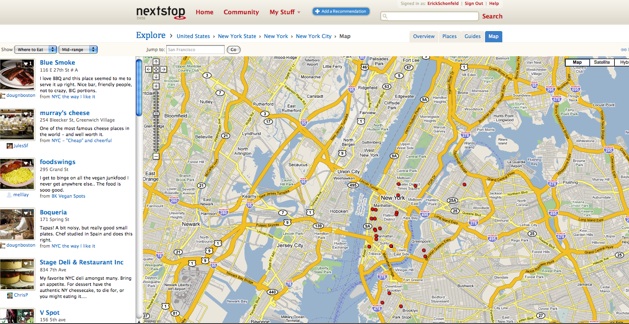
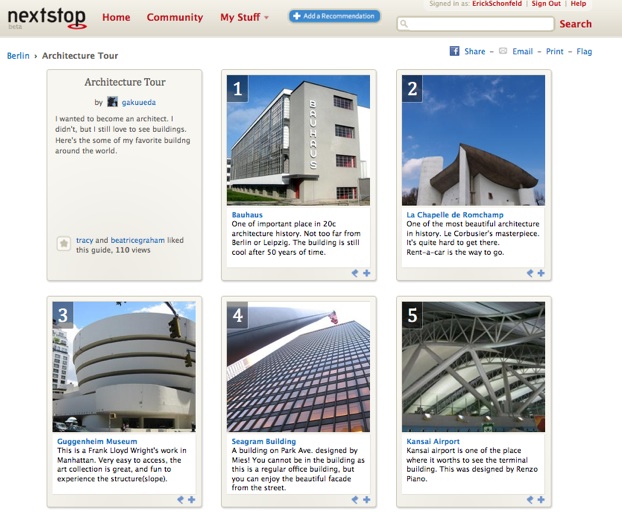
Everything on nextstop is geared towards getting people to recommend their favorite places and organize those recommendations into guides. There are various ways to explore the site, including a search box, by city, a guide view, or a map view (see screen shots below). The recommendations can be collected together into guides (like this one for an architecture tour), which can be explicitly "liked" by members. The guides can be sorted by most recent, most liked, or most viewed. You can save any place or guide in a wishlist for later viewing.

But it is the social aspects which give the site an extra edge. Each recommendation acts as a vote (for any given place, you can see how many people recommend it) and you can also vote individual recommendations up and down. Every member gets areputation score. You get 2 points every time somebody else votes up one of your recommendations, and 15 points when they "like" one of your guides. To fight spam, your reputation score goes down every time somebody votes down one of your recommendations or flags one of your entries. Entries can also be edited wiki-style. Still, it would be fairly easy to game the system with a few friends.

The members with the most points get recognized on a leaderboard. And you can follow any other member, which lets you see all of their entries and actions on the site in an activity stream (which you can export to other services as an RSS feed). In addition to the reputation points, members can also earn "badges" for accomplishing certain goals, such as being the first to recommend a place, for getting 100 views on a guide, or 10 likes. Any recommendation can be shared via email, Facebook or Twitter (but sharing is not automatic, it has to be explicitly selected for each recommendation). Individual guides can also be shared as embeddable badges or widgets.

The site makes very simple to create a recommendation. These are not meant to be in-depth reviews, rather curated suggestions of things to do. It uses a combination of search APis from Google (for local search, geo-location, image search, and maps) and Yahoo Boss (also for image search) to help you find and auto-complete many of the items that go into each recommendation.

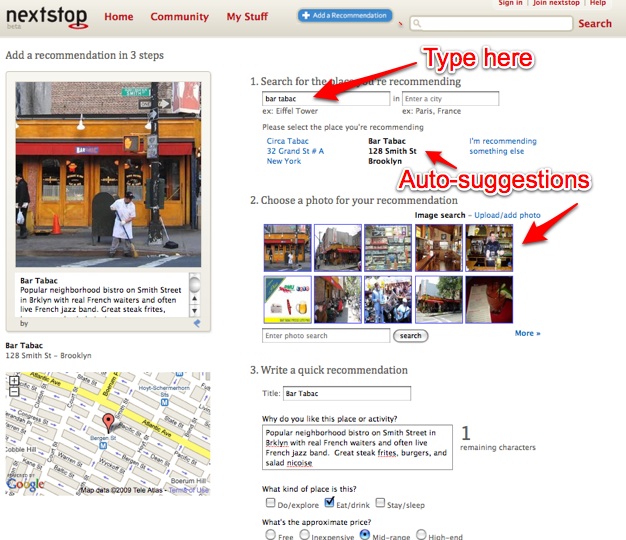
Once you create an account or sign in using Facebook Connect, you can type in the name of practically any bar, restaurant, tourist attraction, or business after clicking "add a recommendation." It will suggest places it recognizes along with their addresses, and if one of them is what you are trying to recommend, you click on it and nextstop will place it on a Google map and find pictures. You pick an image, add a short Twitter-length recommendation no more than 160 characters, and categorize it as a place to eat/drink, stay/sleep, or do/explore along with an approximate price range (free, inexpensive, mid-range, high-end). Then the recommendation is created and other people can find it on the site. I did this for a restaurant in my neighborhood in Brooklyn, Bar Tabac, and it found it immediately, along with a great picture.

There is plenty of competition for online travel guides and social recommendations, starting with TripAdvisor and Yelp down to a bevy of startups including Dopplr, Offbeat Guides and TripSay. But nextstep manages to do things a little bit different. It is not trying to be comprehensive, it is just trying to provide travelers a highly selective and vetted list of things to do and places to visit.


Blog Archive