Monday, April 27, 2009

Getting to the point

Have Kindle, Will Travel — And Stay Up-To-Date Thanks To Offbeat Guides

Posted: 26 Apr 2009 10:00 PM PDT

3476985377_9ce509d49aI used to think the Kindle was stupid. Then I bought one and realized I was wrong. It's still way too expensive, but it's great at what it does. And what it does keeps on expanding. Now, it takes a step into the up-to-date travel guide market, with a partnership with the customizable travel guide service, Offbeat Guides.

Starting tomorrow, you'll be able to find 500 of the company's newest guides in the Kindle store at prices ranging from $3.99 for smaller cities to $7.99 for larger ones. Here's why these are great. Just like the Offbeat Guides regular guidebook products, its Kindle-ready guidebooks are way more up-to-date than traditional guidebooks. While there have been some guidebooks available on the Kindle in the past, most are only updated once a year. Offbeat Guides are updated every month.

This means they can include information such as real-time events for specific cities, like concerts or festivals. It also means the guides can have a Kindle menu option to find out something going on in the city you are visiting that night. For tourists who don't know anyone in a particular city, that's a great feature.

There are a couple downsides. Naturally, because the Kindle only handles grayscale images, you won't get the full color pictures you usually find in other tour guides. And because the Kindle's screen isn't ideal for displaying maps, tailored, local maps that are a part of Offbeat Guides regular guides aren't included here.

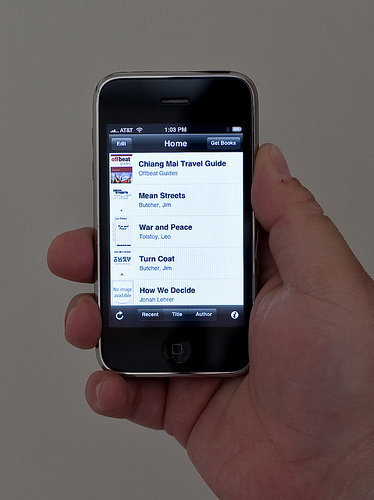
But, at 10.2 ounces (for the latest version), the Kindle is likely lighter than regular tour guides. And, if you're planning a multiple city trip, you can obviously load up a bunch of these guides on one Kindle. One thing that particularly excites me is the fact that you can also view these on your iPhone if you go somewhere and don't feel like carrying around a Kindle. Because the Kindle app on the iPhone stays in sync with the Kindle content, you can bookmark pages and look at them later on your phone.

Offbeat Guides has been working on these Kindle-tailored guides for 6 months now, CEO Dave Sifry tells me. He also notes that there are 5 times as many cities available as compared to other guides. Right now, if you plan on traveling to a city often and want the most up-to-date guide, you'll have to buy a new one each time. But Sifry says they will explore the possibility of having subscriptions for certain cities if customers demand that. Such a feature may even be useful to locals of a particular city to know what is going on. But the focus right now remains on leisure and business travelers, he says.

Find a full list of the Offbeat Guides Kindle options here.

Table of Contents of the May 2009 San Francisco Offbeat Guide on 3477796562_c9ed04f47d

Wednesday, April 08, 2009

Holy dumb name

April 8, 2009 10:01 AM PDT CNET

Hotelicopter is real, though simply a travel search engine

Hotelicopter the travel search engine is not nearly as exciting a concept as a converted Soviet chopper-turned-air hotel, but it does an admirable job at scouring the Web to find you deals on hotel bookings. It searches and aggregates the results from more than 30 different hotel deals sites like Priceline, Hotels.com, and Booking.com, and jumps you straight to each provider's purchase page.

One of its nice features is the option to narrow down the area of a town for which you want it to search for results either through a drop down list of neighborhoods or by drawing a fence within the results map. It will then refresh with results only from that area, right down to a half-block radius. This can be handy if you know the place you're visiting.

Included is the option to log in and link it up with your Facebook account using Facebook Connect, which for now is simply a way to bypass registering with the site, and promote that you're using it on your profile every time you book a trip. What would be far more interesting though, is if it pulled a Dopplr and would let you know a friend who lived in each place where you were planning to travel. That way you could ask if you could couch surf and save some money. Of course, that's not how Hotelicopter makes its money, which is in referrals to all these booking sites and on-page Google ads, but I think it would make for a far more compelling product.

Hotelicopter lets you narrow down the results you want to see by simply drawing a fence around an area of the map. You can also filter by neighborhoods.

(Credit: CNET Networks)

Friday, March 27, 2009

A Microcosms influence

Mayor proclaims economic recovery
By Ian Holroyd
News
Mar 26, 2009

ayor Rob Burton proclaimed the beginning of economic recovery to Oakville's business community in an act of defiance against what some have called a self-imposed recession.

Burton made the announcement at the presentation of the Town's new economic development strategy to the Chamber of Commerce last Friday morning at the Holiday Inn on Argus Road.

"Here and there, the signs of recovery are appearing and they're interesting," said Burton. "As a matter of fact, some people say that we declared ourselves into this recession so maybe what I should do is declare the beginning of recovery here this morning."

In order to perpetuate the economic rebound, Council's economic development strategy focuses on maintaining and further developing established businesses, forging new business relationships beyond the town's borders and building on Oakville's strengths.

The Mayor said in his speech that Town Hall has pledged to open the lines of communication between its Councillors and the business community in order to aid businesses in navigating government regulations to encourage further development.

Also, Council's creation of the economic development department last year has unlocked a user-friendly access to information at Town Hall for Oakville's business community.

On the international stage, a delegation from Neyagawa, Japan, Oakville's sister city, will be coming to ring in the 25th anniversary of the union this July.

Burton said that Oakville should build on this relationship in order to open up Asian markets to Oakville businesses.

The Mayor didn't come right out and say he was actively pursuing another sister city, but he did say that Neyagawa had set a good example by solidifying another alliance with a city just outside of Shanghai, China.

"Fifteen years ago, they created a sister city relationship with a place called Lu Wan," said Burton. "You can see Lu Wan is in relation to Shanghai, the worlds largest city, as Oakville is to the GTA."

He went on to say that over the next 20 years, China will be embarking on a number of extensive projects including skyscrapers, mass transit systems and road building.

"We have business knowhow that they want and value," said Burton, "so I ask the business community today, who wants to be next? And I ask who wants to be left behind?"

Oakville's position in the centre of a life sciences corridor that stretches between two research hubs in Toronto and Hamilton is an advantage that is being explored.

"If we can get a piece of the life sciences development action in Ontario by providing a location for mid-sized companies to set up their facilities," said Burton. "By identifying this goal now we can assure the land is developed appropriately."

To further attract the life sciences industry, the town is developing a district energy plan for a life sciences centre located around the new hospital being built at Third Line and Dundas.

Another strength that Oakville is hoping to cash in on is Sheridan Institute of Technology and Advanced Learning.

They have rightfully earned an international reputation in the digital media and animation industry.
"It makes sense for the town to explore how this expertise can be leveraged with a view to building related business opportunities here in Oakville," said Burton.

The Town will consider in its plan the creation of an international hub for digital media and animation.

A significant component of the Town's strategy is its 770 hectares of vacant employment lands. The goal of the Town is to lure the most valuable development possible.

"Office development attracts an average of $85,000 per hectare of taxes to the town as opposed to only $33,000 per hectare for industrial warehousing," said Burton. "Office development also offers better jobs than warehousing; they pay more. This type of development may take longer to attract but this council is prepared to wait because the end result better reflects the need of our community for well-paid jobs.

"We are finding that there's a good market for office development in Oakville. In 2008 there was approximately 275,000 square feet of office space leased in Oakville and 90 per cent of that activity can be attributed to new head leases versus renewals."

Burton said the draft of Oakville's economic strategy will go to Council in April and he invited input from the business community.

He concluded, "I believe that if we work together and apply our imagination and our creativity, there is no direction ahead of us except onward and upward."

***

Positive Market News

The facts and figures are showing a steady improvement in Canada's economy with retail sales and auto sales on the rise.

Statistics Canada reported an 1.9 per cent increase in retail sales in January. In addition to this, the auto sector saw a rise of 5.5 per cent in the sale of new motor vehicles in January.

Specifically, the sales of North American-built cars was up 3.5 per cent.

Source: Statistics Canada

Friday, March 20, 2009

Why go?

VisitBritain to lure more travellers through virtual link-up


Virtual walking tours of key UK cities are to be made available on the internet through a tie-up between VisitBritain and Google.

The new Google Street View technology will feature 25 cities and towns in Britain and Northern Ireland. 

Users of Google maps can use the Street View mapping to get an idea of the sights they can see when visiting Britain.

They will be able to take a virtual walking tour of destinations such as London, Cardiff, Belfast and Edinburgh, and from Southampton to Aberdeen, Bristol to Norwich.

VisitBritain has worked with Google to create a visual guide - called a maplet - directly in Street View which features sights in London, Cardiff, Edinburgh, Glasgow, Birmingham, Cambridge, Leeds and Oxford.

This maplet then links to VisitBritain's global website, visitbritain.com, where users can access some of its 1,000 destination guides. Each guide further helps them plan their trip with information about where to stay, shop and eat out, as well as the attractions, events and experiences.

This year an extra five million people may consider a holiday in their own country, according to VisitBritain ahead of British Tourism Week next week. Meanwhile, international visitors can taken advantage of improved exchange rates on their trips.

VisitBritain head of online marketing Justin Reid said: "We're very excited to be working with Google on the launch of Street View in the UK. The internet is an incredibly rich resource for raising awareness of destinations, driving travel to and around Britain. Street View is a real opportunity for us to showcase our destinations to millions worldwide.

"Seeing some of our globally-renowned attractions – a mix of old and new – up close, could inspire many more people to visit our shores.

"Our partnership with Google will also mean Street View explorers can find information about the different destinations and attractions, as well as value for money experiences, onwww.visitbritain.com."

Google's geospatial technologist Ed Parsons said: "Street View has been hugely popular with our users in Europe and worldwide and we're thrilled it's now available in UK for so many great cities, enabling users to see street-level panoramas of major city roads and look up and print out useful driving directions."

Sunday, March 15, 2009

Overzealous positioning

"Psychographic, attitudinal and lifestyle data is beginning to be incorporated" - CRM and Loyalty Special

Published: 23 Feb 2009

Investing in technology and research that explains when/where/why a particular consumer is likely to purchase is where the hospitality industry should go next.

This was recommended by a senior CRM executive from Starwood Hotels during one of EyeforTravel's conferences a couple of years ago. It was recommended as a way to go forward considering that as an industry hotels have a long way to go in talking to guests about the product, its attributes, locale, etc. in a way that each individual guest wishes to receive that information.

As a collaborative effort by industry participants it could be a valuable exercise, saysSandeep Govil, Director of Revenue Management and Science Analytics, Wyndham Hotel Group.

"Funding and governance of such an industry initiative will not be easy. As travel markets evolve and events shape local destination attractiveness this research has to be ongoing and industry databases would have to be created to maintain such information. Further, user guidelines have to be defined. Participants have to understand how to leverage such information in value creation. This information could aid the participants in development, database marketing, product and travel package development etc," elaborated Govil.

Govil highlighted that various views of such information are available in data warehouses maintained by individual players in the industry. Package sales across the providers' offerings also provide valuable information today to each player including suppliers and distribution networks. Some of these have reasonably large databases with millions of customers and transactions and can already provide a wealth of information based on fairly large and representative sample sizes.

"The key questions to be asked in trying to initiate an industry wide collaborative effort are to define how this information will be used to create value. We should answer that question first and assess what incremental benefit it will create for suppliers, distribution players and customers," Govil told EyeforTravel.com's Ritesh Gupta.

In the past the travel industry has worked hard to collect data on each guest that can be acted upon. For example, targeting messages to a specific guest type based on a set of factors. Do these segments reach beyond fairly common demographics and behaviour data?

Commenting on this, Govil said, "There has been significant progress made in leveraging these insights to execute marketing campaigns both direct/e-mail and traditional media based. Psychographic and attitudinal and lifestyle data is beginning to be incorporated at least on pilot basis to assess lift from these insights. Purpose of travel as well as the composition of the travel party is also being assessed and used. Destination preferences and season preferences are also being used."

"Also, a lot of convincing still needs to be done and hard returns documented so that such additional spend in information sourcing and execution can be justified," he added.

Execution of CRM and measuring loyalty

Experts feel there is a great opportunity in hotel programmes to increase customer loyalty. The missing links are less about the technology and more about their data capture capabilities, and their ability to provide a differentiated and relevant customer experience in a franchised network.

"Loyalty in the travel and hospitality industry is hard to measure and share of wallet type information is not readily available," says Govil.

Most customers determine suppliers and booking channels based on many factors contingent upon the circumstances around the specific travel.

"Data has shown that most of the valuable customers for one supplier are also valuable customers for other suppliers," shared Govil.

When it comes to executing CRM effectively, Natasa Christodoulidou, Ph.D. California State University – Dominguez Hills says the biggest challenge in the same is to indulge into the luxury market as much as possible. "For example, research shows us, that if you offer a customer $100 off a vacation package or $100 in gas money they would not be as thrilled, had you offered them a suite upgrade or a luxury dinner for two in an exclusive restaurant when they arrive at their destination."

Suppliers are discovering that there is a world of marketing potential in the rich store of redemption information that can be leveraged from a loyalty programme. This does not require access to information at the individual customer level, but does open up the ability to develop full customer profiles from aggregated data. This is an under-leveraged tool in retail to understand who is buying their product, and to market cross-sell and up-sell opportunities.

At the same, the biggest initiative taken by suppliers in CRM have been related to guest recognition.

Companies need to create value for the customer when asking for personal data. Allowing guests special access to services and/or functionality is one way to create value in exchange for information.

According to Natasa, the key to working on CRM data gathering approaches in a manner that engages the customer as little as possible while obtaining the information that makes the biggest impact on the goals as a service provider is simply personalisation.

"Many customer will gladly share some data if they feel that it will help the company to personalise the travel promotions to their needs," she says.

Tuesday, February 24, 2009

“The days of the simple online flight-booking engine are numbered”

Home » EyeforTravel News » Airlines » "The days of the simple online flight-booking engine are numbered"

Published: 24 Feb 2009

SITA has stated that with the rise of social networking over the Internet the days of the simple online flight-booking engine are numbered.

"Web 2.0 technologies will transform airline websites into travel planning portals that go far beyond date and location. By making it faster, easier and more cost-effective to provide real-time content from diverse sources, Web 2.0 technologies meet travellers' demands for greater information and personalisation," said Jim Peters, CTO, SITA, as the company marked its 60th anniversary with a look at how technology will change the face of air travel over the next five years.

"In the near future when a customer makes a booking, the airline website could extract the passenger's preferences from its frequent flyer programme, combine it with external content from travel web sites so that hotels, restaurants and tourist attractions can be overlaid on a Google map and the traveller can then take a virtual sight-seeing tour and be linked in with friends' travel plans."

SITA forecasts that mobile devices are about to have the same impact on the passenger journey as the jet engine did 50 years ago.

"Mobile phones are fast becoming access points to online services and over 90% of passengers carry them. Digitally-equipped passengers will access all their travel needs while on the move including purchasing airline tickets and checking-in. Mobile boarding passes could save the industry $500 million as we move towards paperless travel," said Peters.

Friday, February 20, 2009

Doing it right

Yelp Can Be Profitable by 2010 Even as Sales Slow, CEO Says 


By Joseph Galante

Feb. 20 (Bloomberg) -- Yelp Inc., the Internet site where consumers read and write reviews of local businesses, will still be able to turn a profit even as advertising revenue growth slows, Chief Executive Officer Jeremy Stoppelman said.

Yelp's diverse group of local advertisers have shielded it from the economic slump and the site can still be profitable by late 2010, Stoppelman said yesterday in an interview.

"As we're trying to sell to high-end restaurants, that's become more difficult," Stoppelman said. "But as we're trying to sell to auto mechanics, that hasn't necessarily become more difficult because people still need to get their car fixed."

Yelp has Web sites for more than 20 U.S. cities and is expanding into the U.K. and Canada. Users rate local businesses on a five-star scale and post comments. The site competes with online directories such as IAC/InterActiveCorp's Citysearch, Zagat.com and YellowPages.com.

Restaurants account for about 30 percent of Yelp's advertising customers, Stoppelman said. Businesses can sponsor their pages and write back to users. They can also pay to be listed at the top of search results and highlight their favorite user review.

The East Bay Express, a weekly newspaper based in Emeryville, California, reported this week that of dozens of businesses it contacted over several months, six said Yelp salespeople had offered to remove negative reviews from the site if they bought ads.

The allegations are "demonstrably false," Stoppelman said yesterday. It's against company policy to offer such deals and no salesperson has the authority to pull reviews, he said.

BlackBerry Application

Yelp, which has developed an application for Apple Inc.'s iPhone, is working to create a similar program for Research In Motion Ltd.'s BlackBerry smart phone, Stoppelman said. That may be ready this year, he said.

Yelp was founded by Stoppelman and Russel Simmons with a $1 million investment from Max Levchin, who co-founded EBay Inc.'s PayPal unit, where Stoppelman was vice president of engineering.

Yelp has raised $31 million in funding and was valued at $215 million after a $15 million investment last year by DAG Ventures, Stoppelman said. Bessemer Venture Partners and Benchmark Capital also own part of the company.

Even amid the economic slump, Yelp hasn't cut jobs. Stoppelman said the company has no plans to seek further investment.

"We feel we can get to profitability on current cash," he said.

To contact the reporter on this story: Joseph Galante in San Francisco atjgalante3@bloomberg.net

Last Updated: February 20, 2009 00:01 EST

Blog Archive